Institut Henri Poincaré, Batiment Perrin, Salle Yvonne Choquet-Bruhat
Moderator: Léonie Canet (Grenoble)
Jérémie Bec (Nice), Rodolfo Cuerno (Leganes), Vivien Lecomte (Grenoble),
Dominique Mouhanna (Paris), Alberto Rosso (Orsay),
Stéphane Santucci (Lyon), Kay Wiese (Paris).
Léonie Canet (Grenoble): The non-perturbative sides of the Kardar-Parisi-Zhang equation. pdf
The Kardar-Parisi-Zhang (KPZ) equation is a celebrated non-linear stochastic dynamical equation yielding non-equilibrium universal scaling. It exhibits notorious non-perturbative aspects. The KPZ fixed point is strong-coupling, all the more in d>1. Strikingly, another, even stronger-coupling fixed point of the KPZ equation, called inviscid Burgers fixed point, has been recently unveiled. These non-pertubative features can be theoretically accessed and studied in a controlled way in all dimensions using the functional renormalisation group. We propose an overview of the related results, which provide a unified picture of the fixed-point structure and associated scaling regimes of the KPZ equation in $d=1$ and in higher dimensions.
Jérémie Bec (Nice): From shocks to stochasticity: Modern perspectives on Burgers turbulence. pdf
The Burgers equation, in one or multiple dimensions and subject to random initial data or forcing, provides a minimal yet powerful setting for investigating open problems in hydrodynamical turbulence. Despite its apparent simplicity, Burgers turbulence exhibits shock-dominated dynamics, anomalous dissipation in the inviscid limit, strong intermittency, and the emergence of (backward-in-time) spontaneous stochasticity in Lagrangian trajectories.
Originally introduced as a pressureless model of fluid motion, the Burgers framework has since become a unifying ground for techniques from statistical physics, stochastic analysis, dynamical systems, and field-theoretic approaches to dissipative anomalies and multiscaling. I will overview what is understood on invariant measures, variational and Lagrangian formulations, and the structure of singularities.
Rodolfo Cuerno (Leganes) : Nonequilibrium critical dynamics: upturns from surface kinetic roughening. pdf
The collective properties that characterize dynamical complex systems often emerge from the interplay at comparable time scales between external driving and dissipation, in such a way that criticality holds without parameter tuning. An example is surface kinetic roughening, ubiquitous across system nature and physical scales to the extent that some of its main instances ---like the celebrated 1D Kardar-Parisi-Zhang (KPZ) universality class [1]--- are recently becoming relevant even to non-interfacial systems.
With a view on the rich structure recently unveiled by this universality class, we will address issues that may enhance our understanding of critical dynamics far from equilibrium. For instance, the extent to which critical exponent values identify the universality class and the roles at this that can be played by the statistics of fluctuations (including their symmetries and physical nature) and by the (type of) dynamic scaling ansatz that ensues. Examples will be drawn from recent work on KPZ-related systems, including Burgers models [2,3], the KPZ equation without surface tension [4] or with columnar disorder [5], or the non-conserved critical dynamics of the Ising model [6].
[1] K. A. Takeuchi, Physica A 504, 77 (2018).
[2] E. Rodríguez-Fernández & R. Cuerno, Phys. Rev. E 99, 042108 (2019); ibid. 101, 052126 (2020); ibid. Phys. Rev. Res. 3, L012020 (2021).
[3] E. Rodríguez-Fernández, S. N. Santalla, M. Castro, & R. Cuerno, Phys. Rev. E 106, 024802 (2022); J. Stat. Mech.: Theor. Exp., 013215 (2025).
[4] R. Gutiérrez & R. Cuerno, Phys. Rev. Res. 5, 023047 (2023); ibid. 6, 033324 (2024); Phys. Rev. E 110, L052201 (2024).
[5] H. Vaquero del Pino & R. Cuerno, Phys. Rev. Res. 7, 043192 (2025).
Vivien Lecomte (Grenoble): From the Directed Polymer to Driven Interfaces.
Rather than following smooth (differentiable) trajectories, Brownian particles trace continuous yet rough (non-differentiable) paths, shaped by persistent thermal fluctuations at finite temperature. This behavior is modeled by random walks, whose large-scale self-similarity is captured by scaling laws and associated exponents. A natural question is how the surrounding environment modifies these paths: how does a walk in a homogeneous medium differ from one in a disordered, inhomogeneous landscape, and how are such differences reflected in the scaling properties? This talk focuses on an example that has attracted intense interest over the past decades: the one-dimensional Kardar–Parisi–Zhang (KPZ) universality class. I will review key results and methods related to the scalings of the 1D KPZ equation. Then I will detail how its static (equilibrium) scaling exponent relates to that of the "creep regime" of a (driven) non-equilibrium interfaces. Finally I will provide a panorama of open questions.
Dominique Mouhanna (Paris): Statistical Physics of Disordered Polymerized Membranes. pdf
Membranes, and more generally random surfaces, form a particularly rich field in
statistical physics, where two-dimensional geometry and thermal fluctuations combine
to produce a variety of unexpected phenomena with applications ranging from high-
energy physics to biophysics. In recent years, polymerized membranes have attracted
renewed interest in condensed matter physics, largely due to the discovery of
exceptional single-layer carbon materials such as graphene, whose mechanical
properties are well described by these models.
In this talk, I will introduce the different classes of membranes — fluid and polymerized
— and discuss the main properties of pure polymerized membranes. I will then review
theoretical approaches to understanding the impact of quenched disorder on the
statistical and mechanical behavior of polymerized membranes.
Alberto Rosso (Orsay): Activated Dynamics and Thermally Induced Avalanches in Driven Disordered Interfaces. pdf
It is well known that quenched disorder leads to the pinning of driven interfaces: at zero temperature, a finite critical force is required to set the interface into steady motion. Near this depinning threshold, the dynamics is characterized by scale-free avalanches and universal critical behavior.
In this talk, I will present recent results on the finite-temperature dynamics of such interfaces at very small drives, deep in the so-called creep regime. In this regime, motion occurs through extremely slow, thermally activated jumps over large energy barriers. Surprisingly, these rare activation events are not isolated but trigger collective, scale-invariant avalanches reminiscent of those at the depinning threshold. I will also discuss how these thermally induced avalanches have a broader relevance to other disordered systems.
Stéphane Santucci (Lyon):
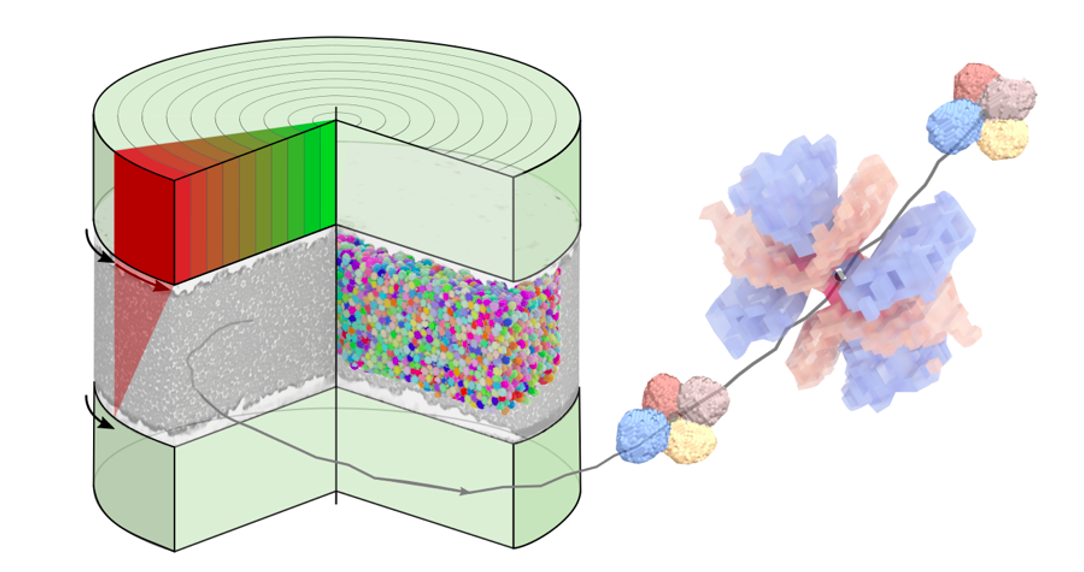
Tomo-rheoscopy of Liquid Foams:
Exploring the Mechanics of Foams, from the Microscopic to the Macroscopic.
Rheology studies how materials respond to mechanical stresses. However, classical techniques
only provide global information (such as viscoelastic moduli), without accessing what happens
at the microscopic scale. This greatly limits our understanding of the mechanics of soft jammed
amorphous materials. These materials — such as gels, pastes, emulsions, foams… — have their
elementary constituents (bubbles, droplets, grains...) densely confined by their neighbors. Yet,
when subjected to stress, these elements can become unjammed and reorganize, leading to
highly heterogeneous deformations and complex structural rearrangements.
To better capture these internal dynamics, we developed a new experimental approach called
tomo-rheoscopy, which combines a shear device with time-resolved X-ray micro-tomography
and applied it to liquid foams. This method allows, for the first time, the tracking of nearly
100,000 individual moving bubbles, while simultaneously accessing mechanical stresses at all
scales — from single bubbles to the entire foam sample. This enabled us to directly link
microscopic structural rearrangements with the global rheological response. We notably reveal
a universal mechanical signature of the topological rearrangements associated to foam flow.
These rearrangements are accompanied by a redistribution of stresses in a quadrupolar pattern
— theoretically predicted but experimentally measured here for the first time in a three-
dimensional material.
|
|
Kay Wiese (Paris): Depinning, sandpiles and hyperuniformity. pdf
The field theory of depinning is build on functional renormalization. Its fixed point can be measured in simulations and experiments. Via an exact mapping, these results carry over to Conserved Directed Percolation, relevant for Manna Sandpiles and Random Organization. As a consequence, density fluctuations there are hyperuniform.